ME495 Aerodynamics Final Project
Air Taxi Rotor CFD Analysis
This past spring, in my Aerodynamics class, our final project was to work in a team to conduct a CFD analysis of a system of our choice. We chose to analyze the vertical-takeoff capabilities of an air taxi, using the Joby S4 as our model.
The goal was to analyze a toroidal propeller at various rotational speeds, signifying different stages of flight. Additionally, we would assess if our findings match experimental data.

Modeling Component
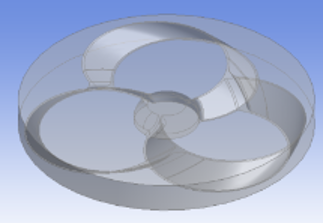
Toroidal propellers are much quieter compared to a traditional helicopter rotor.
We initially used a simplified geometry to confirm methodology before moving on to this ideal model.
Because the model is at a much smaller scale than the typical helicopter rotor, we applied a Reynold’s number correction to the simulation, to ensure the dynamics would remain consistent across length scales.
Methodology
We employed a rotor-stator methodology in which the inner fluid domain (containing the propeller) rotated while the outer fluid domain remained static.
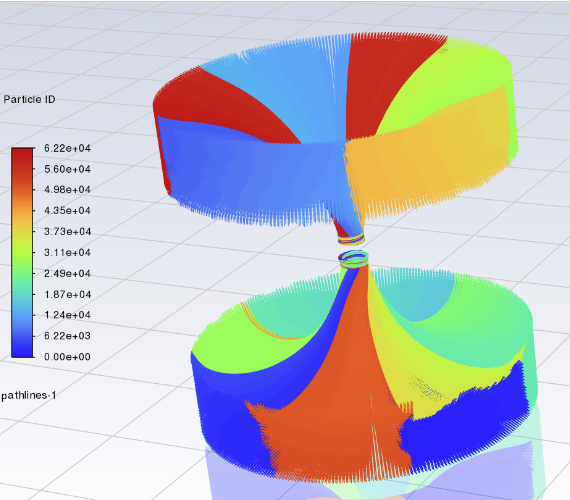
We then conducted a high-fidelity transient simulation (in Ansys Fluent) with a time step dt = 0.005s and N = 400 time steps.
Results
While we struggled to get convergence on the more complicated model, our quantities of interest did approach steady values.
Additionally, we used the simplified Rankine-Froude model to compare our results to ICAS experimental results on the Joby S4. We found that our results were a good prediction of the velocity induced by the S4 during climb (though, there was some discrepancy as the Rankine-Froude model assumes the rotor is in hover).
Y. Fukumine, Z. Lei, “Estimation Of Evtol Flight Performance Using Rotorcraft Theory,” The International Council of the Aeronautical Sciences. https://www.icas.org/icas_archive/ICAS2022/data/papers/ICAS2022_0408_paper.pdf